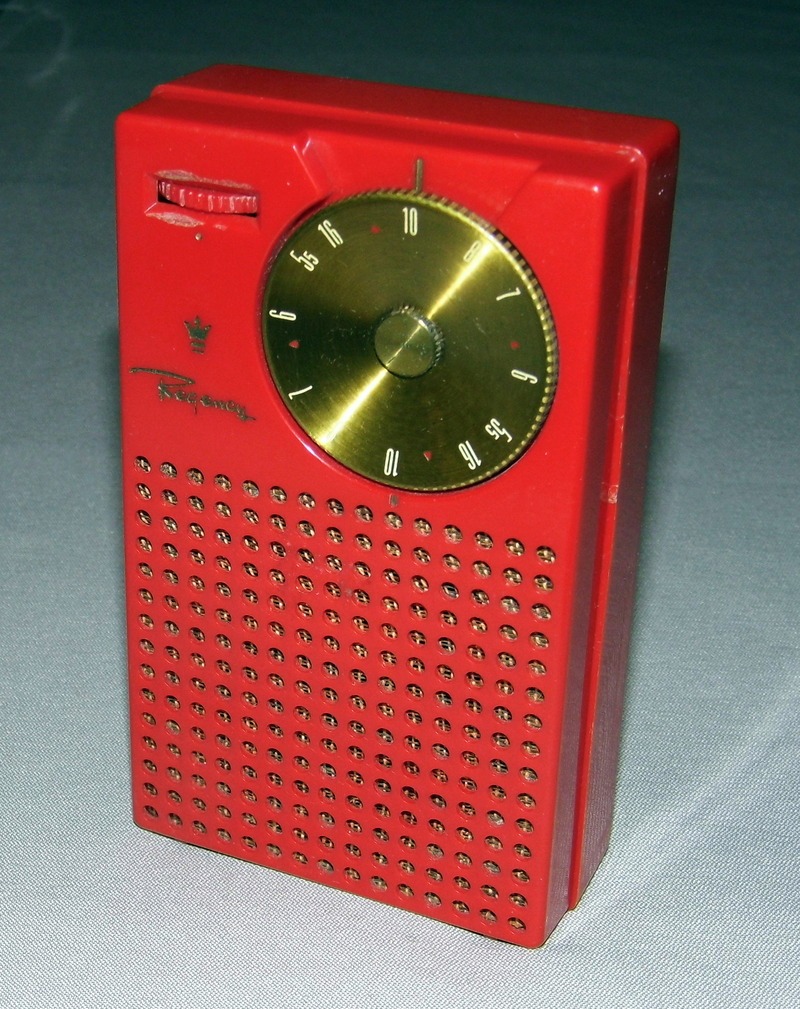
The Regency TR-1 in mandarin red, the world's first commercially sold transistor radio, 1954.
Photo: Joe Haupt via Wikimedia Commons, CC BY-SA 2.0 (resized)
Photo: Joe Haupt via Wikimedia Commons, CC BY-SA 2.0 (resized)
Chapter 14, Section 4
Part of AM Radio Facts and Trivia: The AM Broadcast Band in the USA. Updated November 15, 2026.
In 1954 the transistor was six years old and had conquered exactly one consumer product: the hearing aid. The reason was money: a transistor cost around $20 against a dollar for a vacuum tube, and Texas Instruments, then a little-known maker of oilfield instrumentation sitting on a production line of germanium transistors, badly needed a product that would make the world want them. TI built a prototype pocket radio and shopped it to the radio industry. Every major maker (RCA, Philco, Emerson) said no.
The yes came from a company almost nobody had heard of: I.D.E.A. (Industrial Development Engineering Associates) of Indianapolis, founded by two ex-RCA engineers, whose main business was TV signal boosters for rural viewers. Under its Regency brand, I.D.E.A. took TI's prototype and made it manufacturable: engineer Richard Koch cut the transistor count from eight to four (each one saved real money) and laid out a circuit board with the components soldered directly on, shrinking everything to fit a case the size of a shirt pocket. From handshake to store shelves took about six months, on a deadline chosen for one reason: Christmas.
Picture 14.4-1
The Regency TR-1 was announced on October 18, 1954 and went on sale in New York and Los Angeles on November 1: four germanium transistors, a 22.5-volt battery good for more than twenty hours, eleven ounces, $49.95, over $500 in today's money, for a radio that, frankly, didn't sound very good. The cost-cutting that got it down to four transistors also gutted the audio output, and reviewers said so. It didn't matter. The TR-1 was sold as a fashion object: mandarin red, turquoise, lavender, pearl white, lime, in an era when radios came in wood-tone boxes, and it was the first radio in history you could carry in a pocket and forget you were carrying. About 100,000 sold in the first year.
What it changed was the relationship between the listener and the AM band. Radio had been furniture: the family gathered around the console. The TR-1 made it personal: rock and roll went to the beach, the ballgame rode in a work-shirt pocket, and a generation of kids discovered nighttime skywave with a transistor under the covers, parents none the wiser, the recruiting tool of the clear-channel DXing hobby. This is also the generation in which the ferrite loopstick became the universal AM antenna: the transistor shrank the radio, and the ferrite bar shrank the antenna to fit inside it (see The Tunable Loop). The transistor portable arguably extended AM's golden age even as television was ending it (see The Golden Age & Decline of AM Radio); the console audience was lost to TV, but the pocket audience was brand new.
The TR-1 also won a race it didn't know it was in. Raytheon crossed the line the following year with a larger "picnic portable," and close behind came an unknown Japanese firm, Tokyo Tsushin Kogyo, whose transistor portables would soon flood the American market, after the company renamed itself something Americans could pronounce: Sony. The TR-1 itself was made for only about a year, which is why survivors are prized collectibles today, selling for thousands of dollars in the right color, and, in fine TR-1 tradition, usually not working.
Sources: Engineering and Technology History Wiki, "T.I. Unveils Transistor Radio"; Wikipedia (Regency TR-1); collectornet.net Regency TR-1 facts and figures; regencytr1.com; EDN, "TI announces 1st transistor radio."
© 2026 Chris, N6JET. Free to read and share for non-commercial use with credit (Creative Commons BY-NC 4.0). Not for sale.
All AM radio stories by subject · AM radio interactive tools and simulators · AM Trivia Challenge quiz
