Ask anyone what Edwin Howard Armstrong invented and you'll hear one word: FM. He is remembered as the father of AM's great rival, the man who spent his last two decades trying to replace amplitude modulation altogether. But the AM band has the stronger claim on him. Of the four landmark inventions Armstrong produced in his lifetime, three of them are the machinery of AM radio's golden age. Every AM receiver built since the 1920s (including the one in your car right now) is, at its heart, an Armstrong design.
Regeneration (1912). As a Columbia undergraduate, Armstrong did what nobody else had bothered to do with Lee De Forest's Audion tube: he measured it until he understood it. Then he fed a little of the tube's output back into its input. In the fall of 1912 that feedback loop suddenly amplified signals a thousandfold: distant stations, which a crystal set delivered as whispers in headphones, now played loudly enough to hear across the room. And Armstrong noticed something more: pushed past a threshold, the same circuit stopped being a receiver and became an oscillator: a generator of clean, continuous radio waves. One discovery had produced both ends of the broadcast chain. Regeneration made the sensitive receiver possible, and the oscillating Audion became the ancestor of every master oscillator in every AM transmitter ever licensed.
The longest patent war in radio. De Forest, who had not understood his own tube, claimed the discovery anyway, and the resulting litigation ran thirteen courtroom battles across twenty years, reaching the U.S. Supreme Court twice. In May 1934 the Court ruled, on the paper record, for De Forest. The engineering profession simply refused to go along: when Armstrong tried to return the Institute of Radio Engineers' Medal of Honor, awarded for regeneration, the Institute's board declined to take it back, and the Franklin Institute later awarded him its Franklin Medal for the same invention. The law said De Forest; the people who actually built radios said Armstrong.
The superheterodyne (1918). Armstrong's masterpiece came in wartime Paris, where he served as a major in the Army Signal Corps working on the problem of receiving very weak, very high-frequency signals. His solution was a piece of lateral genius: don't fight the incoming frequency at all. Mix it with a local oscillator inside the receiver, convert any station to one fixed intermediate frequency, and do all the difficult amplification and filtering there, at a frequency the engineer chooses once and optimizes forever. Tune the front end, and the rest of the radio never changes. He patented it in 1920 and sold it to Westinghouse that fall for $335,000.
The superheterodyne is the reason AM broadcasting could become a mass medium. Early regenerative and tuned-RF sets demanded a skilled hand on multiple dials; a superhet brought in stations with one knob, and it could be mass-produced cheaply because the critical IF stages were identical in every set. RCA's Radiolas carried it to the public in 1924, and by the mid-1930s essentially every AM receiver made was a superhet, a state of affairs that has never reversed. The All American Five is Armstrong's architecture distilled to five tubes: the 12BE6 converter is his mixer and local oscillator in a single envelope, the 12BA6 is his IF amplifier, the 12AV6 his detector. Even today's DSP car radio chips begin by doing, in silicon, exactly what Armstrong did in Paris with triodes.
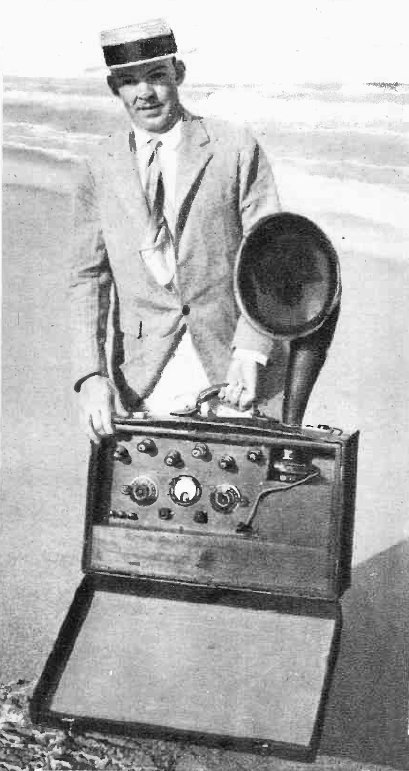
Armstrong, 1923, with the first portable superheterodyne receiver, built as a wedding present for his bride, Marion, and carried on their honeymoon. The architecture inside this suitcase is the architecture inside every AM radio since. (Photo: public domain, via Wikimedia Commons.)
Picture 14.2-1
Super-regeneration (1922), and a seat at RCA's table. Armstrong's third invention squeezed still more amplification out of a regenerative detector by quenching it in and out of oscillation thousands of times a second. RCA bought it for cash and stock, a deal that made Armstrong the largest individual shareholder of the Radio Corporation of America. It also brought him into David Sarnoff's offices, where he met and married Sarnoff's secretary, Marion MacInnis. Super-regeneration never conquered broadcast receiving, but it lived for decades in police radios, aircraft sets, and eventually garage-door openers and radio-controlled toys.
The irony. Having built AM's transmitters a clean oscillator and AM's listeners the perfect receiver, Armstrong spent the 1920s attacking the one enemy left: static. His conclusion, that the answer was not a better AM receiver but a different modulation entirely, became wideband FM in 1933, and it set him against the industry his patents had built, including RCA itself. The fight over FM's spectrum, royalties, and credit consumed his fortune and his health, and on February 1, 1954, Armstrong took his own life. His widow Marion carried on the infringement suits against the radio industry, and won or favorably settled every one of them.
FM got his last twenty years. But AM got the first twenty: the regenerative detector that made broadcasting worth listening to, the oscillator at the heart of the transmitter, and the superheterodyne inside every radio on the band. By any honest accounting, every AM radio is an Armstrong radio.
Armstrong's superheterodyne, 1918: inside every AM radio since the 1920s. The gold labels show where each job lives in the All American Five.
Drawing 14.2-2
Sources: Encyclopaedia Britannica (Edwin H. Armstrong); IEEE / Wireless History Foundation; Linda Hall Library; Mayo Clinic Proceedings biographical sketch; Lawrence Lessing, Man of High Fidelity.