Drive past certain AM sites and the tower is wearing something: a wheel of horizontal spokes at the very top, like an umbrella frame stripped of its fabric, or a ring of wires sloping outward to the upper guys. That's a capacity hat (or top hat, the FCC calls the general technique top loading), and it's one of the oldest and most elegant tricks in antenna engineering: it makes the tower electrically taller than it physically is.
The problem: current has to be zero at the top. On a plain series-fed tower, the RF current distribution is a piece of a sine wave that must fall to zero at the tip: the top of the tower is an open circuit, and the current simply has nowhere to go. But it's current flowing along the steel that does the radiating; the figure of merit is ampere-meters, current times length. That forced zero means the top of every plain tower is loafing, and a tower much shorter than a quarter wave is doubly punished: little radiating current, low radiation resistance, a large capacitive reactance to tune out, narrow bandwidth, and a bigger share of the transmitter's power burned up in the loading coil and ground system instead of leaving as signal.
The fix: give the current somewhere to go. The hat is one plate of a capacitor; the earth is the other. With that capacitance sitting on top, charge can flow up the tower and out onto the spokes, so the current at the top of the vertical section no longer has to be zero. Electrically, the missing top of the sine wave has been grafted onto the hat. And because the hat's currents flow horizontally and symmetrically outward, their radiation largely cancels; the hat itself stays quiet. All it does is force the vertical steel below it to carry higher, more uniform current along its whole height. Same tower, more ampere-meters, more signal. A modest hat can add tens of electrical degrees: a stubby 60° stick behaves like a quarter-wave radiator, with the radiation resistance up, the reactance down, the bandwidth wider, the base voltage lower, and less power wasted in loss resistance. That's the whole story of the title: more degrees without more feet, valuable when the FAA, the neighbors, or the budget put a ceiling on the steel (see the 200-foot rule).
Two ways to wear it. The textbook hat is the spoked wheel: rigid radial rods at the tip, sometimes joined by a perimeter ring. The thriftier version uses what's already up there: insulate the top set of guy wires at a calculated distance from the tower and let those sloping wire segments be the hat. Plenty of top-loaded entries in the FCC database are exactly that: guy-wire top loading, invisible unless you know what to look for. (Sectionalized towers, the other current-shaping trick, get their own treatment in Feeding the Tower and the WHO writeup in Antenna Oddities.)
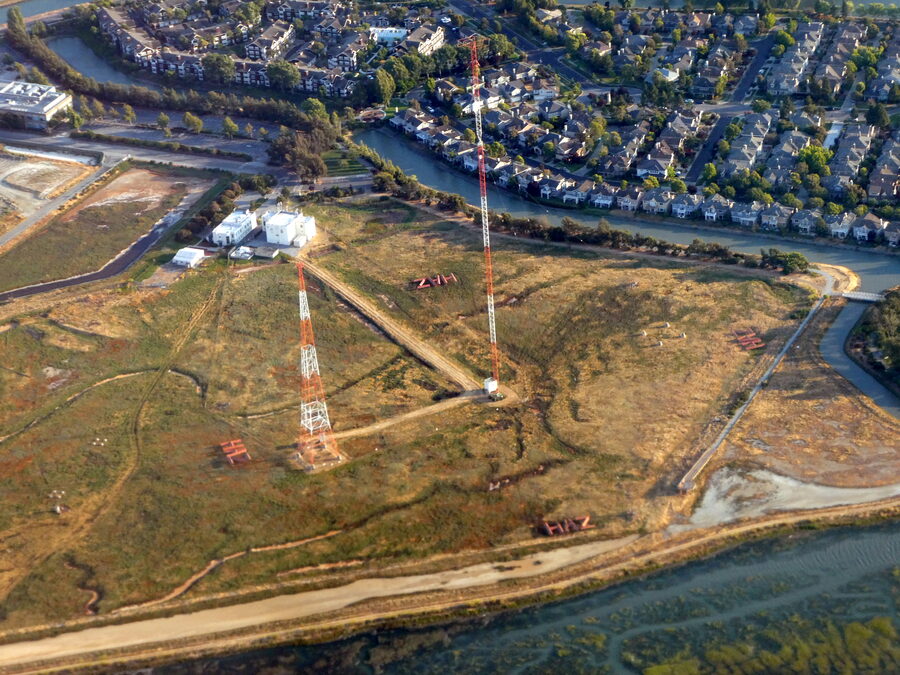
KNBR 680: the hat that completes a Franklin. The Bay Area's marquee example is the best kind: the hat isn't rescuing a short tower, it's impersonating steel that was never built. KNBR's 550-foot main tower at Belmont Shores, completed in 1949 when the station was KNBC (it had been KPO until 1947), is a modified Franklin antenna, the same family as KFBK, KSTP, and WHO in Antenna Oddities. A true Franklin stacks two half-wave radiators end to end and feeds them in phase; at 680 kc that's about 1,500 feet of tower, an obvious impracticality. So the designers built the lower half wave honestly (400 feet of steel up to the midpoint porcelain insulator) and faked the upper one: a top section of just 150 feet, with the missing length made up by a fifty-foot-diameter capacity hat at the summit. The upper section is shunt-fed from a tap on the lower section, through a copper tube running up the tower on insulated standoffs. Electrically it's two half waves in phase; physically it's barely a third of the steel, with the hat covering the difference. That's the capacity hat at maximum ambition: not adding a few degrees to a stubby stick, but finishing a half-wave radiator out of thin air. There's a performance tax on file, too: the loading network in the doghouse is so sharp (such high Q) that there isn't enough bandwidth for HD Radio sidebands, part of why 680 never ran IBOC. Put that hatted near-Franklin on Belmont's salt-marsh conductivity (see Towers Near Water) and you get a 50 kW signal that sounds local from Sacramento to Monterey, and reaches Hawaii at night. Fitting, finally, that the same site ran one of KPO's original flat-top wire antennas until 1949, when this tower replaced it: one patch of Bay mud that has personally lived the whole arc from wire antenna to hatted Franklin. And the construction crew left us a vertigo souvenir: Chief Engineer Joe Baker standing on top of the brand-new tower at the hat, 1949, knuckles white on the beacon housing, preserved in John Schneider's Radio Historian archive.
KNBR 680's transmitter site on the bay marsh, 2024, the hatted, modified-Franklin main tower and its auxiliary (the surviving 1933 KPO tower), on the same ground that carried KPO's flat-top wire antenna. Salt marsh below, capacity hat above: the two best signal multipliers a 50 kW station can own. (Photo: Pi.1415926535, CC BY-SA 4.0, via Wikimedia Commons.)
Picture 2.6-1
Spotting them. Once you know the silhouette, hats are everywhere: the spoked crown on a short suburban stick squeezed onto a small lot, the subtle umbrella of insulated upper guys on a daytimer, WHO's 745-foot top-loaded giant in Des Moines, WDRU's four-tower top-loaded array in North Carolina (both in the 50 kW records table). Every one of them is the same dodge: when you can't buy height, buy capacitance.
Why the hat works. A bare short tower wastes its height on a current taper forced to zero at the tip. Add the hat and the current has somewhere to go: the same steel carries nearly full current top to bottom.
Drawing 2.6-2
Sources: NAB Engineering Handbook (medium-wave antennas, top loading); ARRL Antenna Book (MF/LF verticals and top loading); Stuart Ballantine, "On the Optimum Transmitting Wave Length for a Vertical Antenna over Perfect Earth" (Proc. IRE, 1924); FCC AM database (top-loaded entries); John F. Schneider / The Radio Historian & Bay Area Radio Museum ("KNBC Radio, Belmont, New Franklin Antenna, 1949"; Belmont photo archive); KNBR Belmont engineering tour accounts.